Pharmacology & Toxicology
Every Cell has a Story to Tell.
Let’s Discover Yours
Pharmacology and toxicology studies with in vitro biological systems allow researchers to evaluate how compounds modulate neuronal function and assess potential safety risks in a controlled, human-relevant context.
Researchers can monitor activity patterns and network dynamics to assess the efficacy, potency and adverse effects of small molecules, biologics or environmental agents on neuronal cultures, organoids or brain slices. These readouts provide essential information on dose-response relationships, therapeutic windows, and compound-specific mechanisms of action, offering translational biomarkers and functional endpoints relevant in clinical trials. When combined with complementary approaches like imaging, transcriptomics, and structural analysis, in vitro pharmacology and toxicology provide a comprehensive view of how compounds influence neuronal health and function from single cells to complex networks.
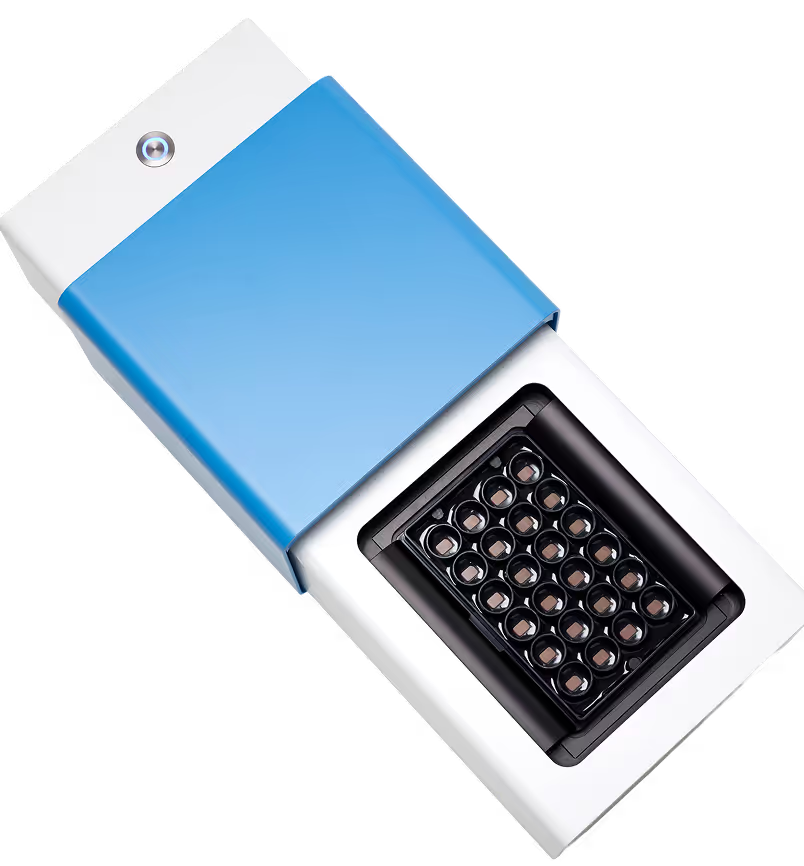
MaxWell Biosystems’ HD-MEA platforms offer unmatched resolution and throughput for pharmacological and toxicological screening. With label-free, high-content recordings from thousands of electrodes across multi-well formats, researchers can detect subtle functional changes, monitor compound effects over time, and compare responses across conditions or cell lines. This enables robust dose-response profiling, safety assessment, and mechanism-of-action studies, all within a scalable, automation-compatible platform designed for reproducibility and translational relevance.
Consistent drug responses with high reproducibility
Pharmacological and toxicological responses can vary across cell types, doses, and replicates. Reproducible functional readouts across wells and timepoints help separate true compound effects from technical noise or variability caused by limited signal coverage, enabling confident, data-driven decisions.
Track compound effects on axonal function
Many compounds influence axonal conduction and growth. High-resolution axon tracking reveals changes in conduction velocity and morphology, helping researchers detect toxicity-related impairments or therapeutic rescue effects on axonal function.
Detect subtle compound effects early
Compound effects may first appear as slight changes in spiking, network dynamics, or excitability. Sensitive detection allows researchers to capture both low-amplitude signals and subtle shifts in activity, enabling early identification of therapeutic action or emerging toxicity.
Scale up screening with confidence
Screening compounds across doses, timepoints, or cell lines requires consistent, high-throughput analysis. Our automation-ready HD-MEA platforms support robust data acquisition and processing, enabling efficient evaluation of drug efficacy, mechanism-of-action, or safety profiles.
Case studies

Dose-dependent response to synaptic blockers
This study used the MaxTwo HD-MEA Multi-Well System to profile the functional response of Elixirgen Scientific (Ricoh Biosciences) Quick-Neuron™ human iPSC-derived excitatory neurons to increasing doses of the synaptic blockers NBQX (AMPA receptor antagonist) and D-AP5 (NMDA receptor antagonist). High-content HD-MEA recordings revealed a rapid and dose-dependent suppression of neuronal firing and network bursting with NBQX, while D-AP5 produced more modest decreases. Recovery of activity after drug washout confirmed assay stability, showcasing robust, reproducible pharmacological evaluation.


Dose-Dependent Effects of NBQX and D-AP5 on Firing Rates in Ricoh Biosciences Quick-Neuron™ Human Excitatory Neurons
Representative network activity plots show suppression of spontaneous network bursts with increasing concentrations of AMPA/Kainate receptor antagonist NBQX (left column) and NMDA receptor antagonist D-AP5 (right column). Washout panels demonstrate recovery of network activity, confirming reversibility and robustness of pharma assay measurements using the MaxTwo HD-MEA system.
Data adapted from the Application Note in collaboration with Elixirgen Scientific (Ricoh Biosciences).

Scalable pharmacological validation of different neuroactive compounds on 3D InSight™ Human Neural Microtissues
The MaxOne HD-MEA System was utilized for monitoring long-term pharmacological effects in human iPSC-derived cerebellar organoid models. Cerebellar organoids were chronically treated with serotonin (5-HT), a compound known to support Purkinje cell maturation. Longitudinal high-resolution HD-MEA recordings revealed that serotonin-treated cerebellar organoids developed robust, synchronized network bursting activity, a key functional indicator of advanced synaptic maturation. Our HD-MEA technology allows sensitive, non-invasive tracking of functional changes in organoids over time, supporting detailed analysis of compound effects on neuronal network development.
慢性血清素治疗对人iPSC衍生的小脑类器官网络活动的影响
上衣: ActivityScan Assay 射速图和网络检测网络活动图显示,未经处理的器官在 DIV 56 处会出现稀疏的、不同步的射击。
底部: 经血清素(5-HT)长期治疗的小脑类器官在 DIV 56 处表现出明显的同步网络爆裂和更高的射速,这表明突触网络成熟度增强。
与里斯本干细胞工程研究小组(SCERG)的安娜·玛丽亚·戈麦斯合作获得的数据。
咖啡因调节原发性大鼠皮质神经元的网络破裂
本研究使用原代大鼠皮质神经元培养物中的HD-MEA记录,研究咖啡因对神经元网络活动的急性影响。与车辆控制相比,咖啡因(1mm)的应用导致了网络同步性的显著变化,包括突发间隔的增加和爆发结构的改变。随着时间的推移,定量分析表明,化合物暴露后的爆发参数发生了显著变化,这突显了我们的 HD-MEA 平台在检测神经元群中药理诱导的网络调制方面的灵敏度。
.png)
Caffeine-induced changes in network activity in rat primary cortical neurons at DIV 15
Top: Experimental timeline and representative network activity plots show synchronous bursting before and after application of caffeine (1 mM) or vehicle control in E18 rat primary cortical neuronal cultures.
Bottom: Box plots illustrate statistically significant changes in inter-burst interval, spikes per burst, and spikes per burst per electrode over time in caffeine-treated and vehicle groups.
Data acquired in-house.