Microscopic view of neuronal cells with branching dendrites over a microelectrode array colored in blue.

Every Cell has a Story to Tell

Accelerate discovery with
next-generation electrophysiology

Empower your research and drive innovation with high-density microelectrode arrays

Characterize

Explore the electrophysiological properties of your in-vitro brain models with high precision, from neuronal populations down to subcellular dynamics.

Screen

Scale up and accelerate your electrophysiological assays with unmatched efficiency, delivering results and insights that truly matter.

Control

Push the boundaries of electrophysiology by designing your own recording and stimulation paradigms or interfacing with engineered microstructures and devices.
Discover the new MaxTwo 24-Well Plate⁺

More Details
More Details
Max
imize the potential of every cell and amplify it for every

Maximize the potential of every cell and amplify it for every Well

Well
Single-Well HD-MEA

MaxOne

Versatility and functionality in one compact device
Discover the MaxOne
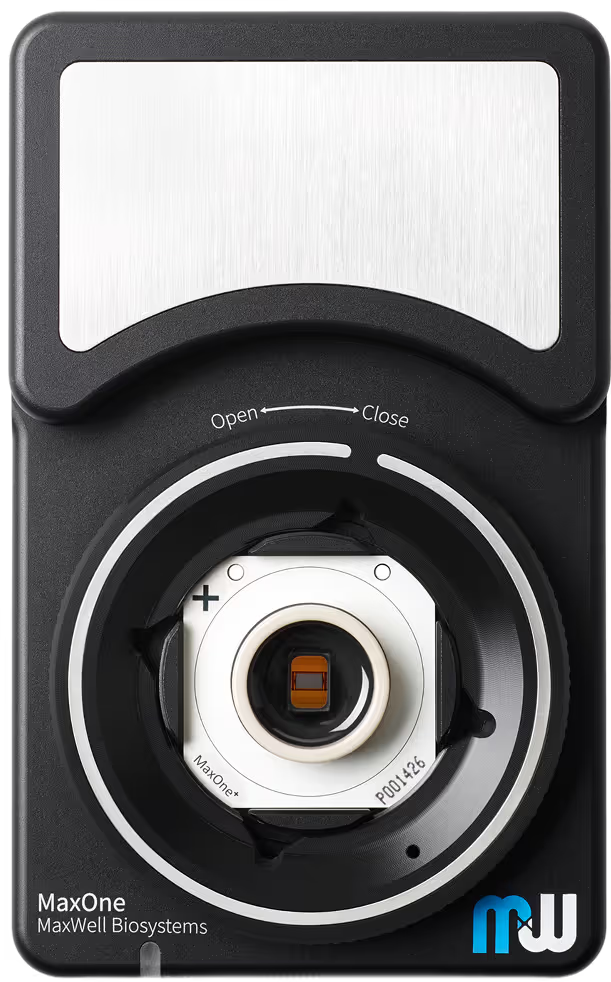
MaxOne device by MaxWell Biosystems with a central MaxOne+ Chip holder and open/close indicator.
Multi-Well HD-MEA

MaxTwo

Maximize your cell functional assays
Discover the MaxTwo
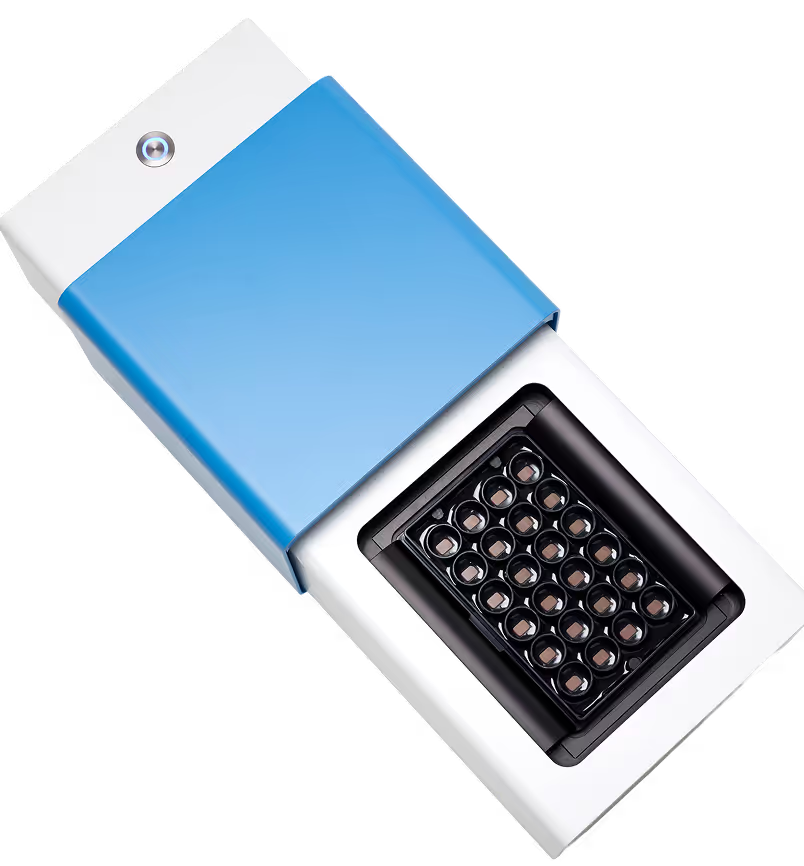
MaxTwo device with a blue sliding cover revealing a black tray holding a 24-Well Plate.

Your Success, Our Commitment

Cutting-edge technology, tailored solutions, and expert support to drive your science forward.

Ultimate signal detection

Capture neuronal activity with unmatched fidelity from population networks to individual axons. Combining industry-leading low background noise with high electrode density, MaxWell Biosystems sets a new standard for superior MEA signal quality.

Our Technology
Our Technology

Versatile solution to your needs

Empower your research with HD-MEA platforms tailored to your workflow - from basic research to screening, neurocomputing, and beyond. Push the boundaries of MEAs with MaxWell Biosystems' advanced technology and interfacing capabilities.

Our Products
Our Products

Accessible knowledge hub

Accelerate your success by exploring easily accessible documentation, benefit from our personalized expert support and training, and connect with our collaborative user community during MaxWell Biosystems events.

Our Resources
Our Resources

Prof. Yoshiho Ikeuchi

Institute of Industrial Science, The University of Tokyo, Japan

“Today, our MaxOne System plays a central role in our work. In fact, it has become a defining element of our research. It allows us to grow organoid-derived neural networks directly on the array surface and record their activity over long periods. This enables us to observe temporal-spatial dynamics, correlations, and sequential patterns of activity, all within a single, integrated system. Given the complexity of the networks we’re studying, the fact that the technology is also easy to use makes it even more valuable.”

Full Testimonial
Full Testimonial

Prof. Kenneth Kosik

University of California, Santa Barbara, USA

“MaxOne opened so many doors in regards to questions of brain wiring, genetics, drug discovery, access to circuitry through organoids, which could not be addressed in any other way.”

Full Testimonial
Full Testimonial

Prof. Feng Guo

Intelligent BioMedical Systems (IBMS) Lab, Indiana University Bloomington, USA

“If you have one electrode covered by many neurons, you acquire average information, which is not enough for specific computing conditions. What we really aim is high resolution at a single-neuron level, something we can achieve with MaxOne HD-MEA.”

Full Testimonial
Full Testimonial

Dr. Tetsuya Tanaka

Ricoh Biosciences, Inc., Baltimore, Maryland, USA

“Unlike other commercially available MEA systems, MaxTwo has an outstanding capability to measure and track action potentials in single neurons due to how the electrodes are arrayed in such a high density manner."

Full Testimonial
Full Testimonial

Dr. Kateryna Voitiuk

University of California, Santa Cruz, USA

“The MaxOne HD-MEA Chips allowed us to align neural activity to histology at comparable resolution. Also, it enabled us to study network activity and the structured spatial dynamics across the sub-regions of the hippocampus during seizure-like activity and optogenetic silencing.”

Full Testimonial
Full Testimonial
previous
Next

Upcoming event

NeuMoS 2026

Organoids, NAMs, and Neural Circuit Assays for Disease and Drug Discovery

Discover the event
Discover the event

Recent Publications

All Publications
All Publications
iScience
|
2026

Unperturbed Dye-based Imaging of Spontaneous Synchronized Calcium Activity in iPSC-derived Neuronal Cultures

Dirkx et al.
Read the publication
Brain
|
2026

Kv7.2 loss-of-function causes early hyperexcitability and network remodelling

Dirkx et al.
Read the publication
Journal of Experimental Medicine
|
2026

Identification of secondary microglial formation centers in the human fetal brain

Song et al.
Read the publication
Nature Communications
|
2026

Defective ventral neurogenesis due to midfetal Chd8 mutation drives autistic-like behavior in mice

Nitahara et al.
Read the publication
Biosensors
|
2026

Microelectrode Arrays Technology for Brain-on-a-Chip Applications

Zhao et al.
Read the publication
Advanced Science
|
2026

Engineering Neuronal Network Connectivity Through Precise and Scalable Electrical Modulation

S. Kumar et al.
Read the publication
Alzheimer's & Dementia
|
2026

Behavior of neural networks in culture suggest that sporadic and genetic forms of Alzheimer's disease may not be equivalent

Ma et al.
Read the publication
Molecular Psychiatry
|
2026

Loss of schizophrenia risk gene XPO7 disrupts neuronal excitability and network regularity via altered Na+ channel dynamics in human neurons

Cui et al.
Read the publication
algorithms
|
2026

In Vitro to In Vivo: Bidirectional and High-Precision Generation of In Vitro and In Vivo Neuronal Spike Data

Shimono et al.
Read the publication
Environment International
|
2026

Human cerebral organoids reveal PFOA-induced axonal injury as a conserved mechanism of neurodevelopmental disruption

Chen et al.
Read the publication