
MxW Workshop - Shanghai 2026
A One-Day User Meeting for Scientific Discovery and Community Exchange in Shanghai.
Place
448 Zunyi Road, Changning District
200051 Shanghai, China
Date
Time
Welcome Remarks
Invited Talks
Reception & Networking

Expanding Frontiers of In Vitro Neuronal Network Electrophysiology
Join us in Shanghai for a one-day workshop dedicated to expanding the frontiers of in vitro neuronal network electrophysiology. Bringing together scientists and innovators in the field, the event will create space for discussion, knowledge exchange, and community connection around the latest advances and applications.
Reserve your spot by registering with the form below.

Confirmed Speakers
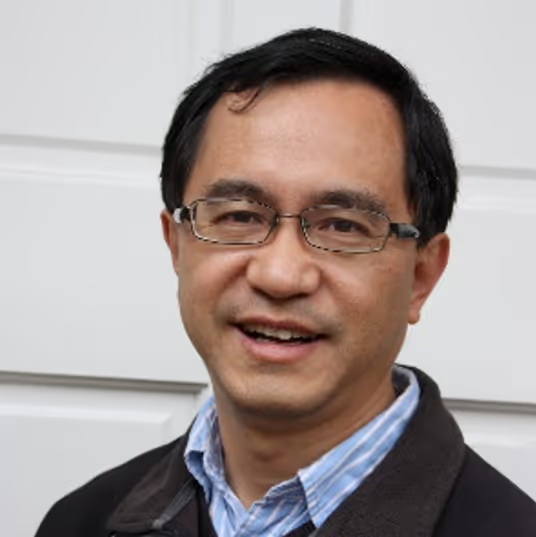
Dr. Shuai Jianwei is a professor at Wenzhou Institute, University of Chinese Academy of Sciences since 2023. He earned his doctoral degree from the Department of Physics, Xiamen University in 1995. He has previously worked at City University of Hong Kong, The University of Electro-Communications in Japan, Case Western Reserve University, Ohio University, and the University of California, Irvine from 1996 to 2007, respectively. In June 2007, he returned to China and was appointed as Minjiang Distinguished Professor at Xiamen University. His research interests cover the fused intelligence, intelligent mechanics, computational biomedicine, artificial intelligence, big data in healthcare, and biological multi-omics analysis. He has published over 260 papers in journals including Nature Cell Biology, Physical Review Letters, PNAS, and Nature Communications.
When AI Meets Mini-Brains: Card-Playing Brain Organoid Agents
Traditional brain-computer interfaces (BCIs) adopt static digital frameworks to decode neuronal networks, which fail to match the brain’s inherent neural coding mechanisms. Closing this compatibility gap is vital for treating neuronal disorders, optimizing brain function, and improving neuroprosthetic accuracy. Combining brain organoids with microelectrode arrays (MEA) creates a humanized in vitro BCI platform with superior biocompatibility for dynamic neuronal decoding. This study addresses the bio-electronic encoding incompatibility via three key advances. It first develops a human-machine hybrid platform integrating brain organoids, high-density MEAs and computational chips for closed-loop neuronal modulation. Second, it builds reconfigurable stimulation nodes to align with organoid electrophysiological states via neural plasticity, eliminating encoding mismatches. Lastly, it establishes the first scalable multi-agent interaction system (MAIS) under shared plasticity rules. Validated in pathological and normal neuronal network models, MAIS acts as a self-evolving neural coding sandbox, laying scalable foundational support for human-centric neural interfaces.

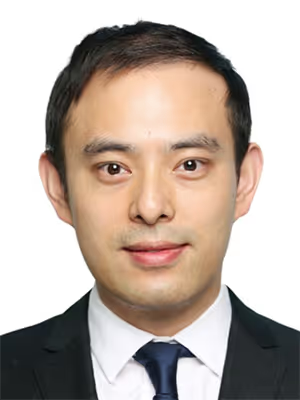


Yiheng Wang is currently a PhD candidate in neurobiology at the Institutes of Brain Science, Fudan University, in Prof. Jiayi Zhang’s laboratory. His doctoral research focuses on visual restoration and retinal decoding, involving novel visual prostheses, High-Density multi-channel electrophysiology, and artificial neural networks. He co-authored a publication in Nat. Biomed. Eng. (2023).
Nanowire artificial retina to improve functional vision
Augmentation of vision has been challenging due to the minimally invasive and sensitive requirements for sighted people. Restoring blindsight while achieving augmentation is an ideal option, and retinal nano-implant emerged as a successful treatment for blind patients. Through rational design and engineering of material distribution, bandgap, interface and intrinsic asymmetry effects, we fabricate and test a retinal nanoprosthesis using tellurium nanowire networks (TeNWNs) for spontaneous efficient photovoltaic conversion in both visible and infrared range, with a medically-feasible invasive rationale for broadband sensitivity. TeNWNs feature record-high spontaneous photocurrent of ~30 A/cm2 and the widest photosensitivity from the visible to an unprecedented NIR-II of 1550 nm. Photocurrents from TeNWNs in 635, 940, and 1550 nm bands elicited photoresponses in retinal ganglion cells and visual cortical neurons of blind mice, enabling them to regain both sub-conscious photosensitivity and conscious light-driven learning behaviors with light intensities (100 μW·mm-2) far below the safe levels. Meanwhile, electroretinogram potentials in the visible and NIR range were observed in the retinas of Macaca fascicularis implanted with TeNWNs. The biocompatibility and safety of implants were further evaluated over multi-weeks. The preclinical validation of TeNWNs in blind mice and primate models enables an encouraging step towards restored visible and augmented infrared-band vision for blind patients receiving retinal implant surgery.
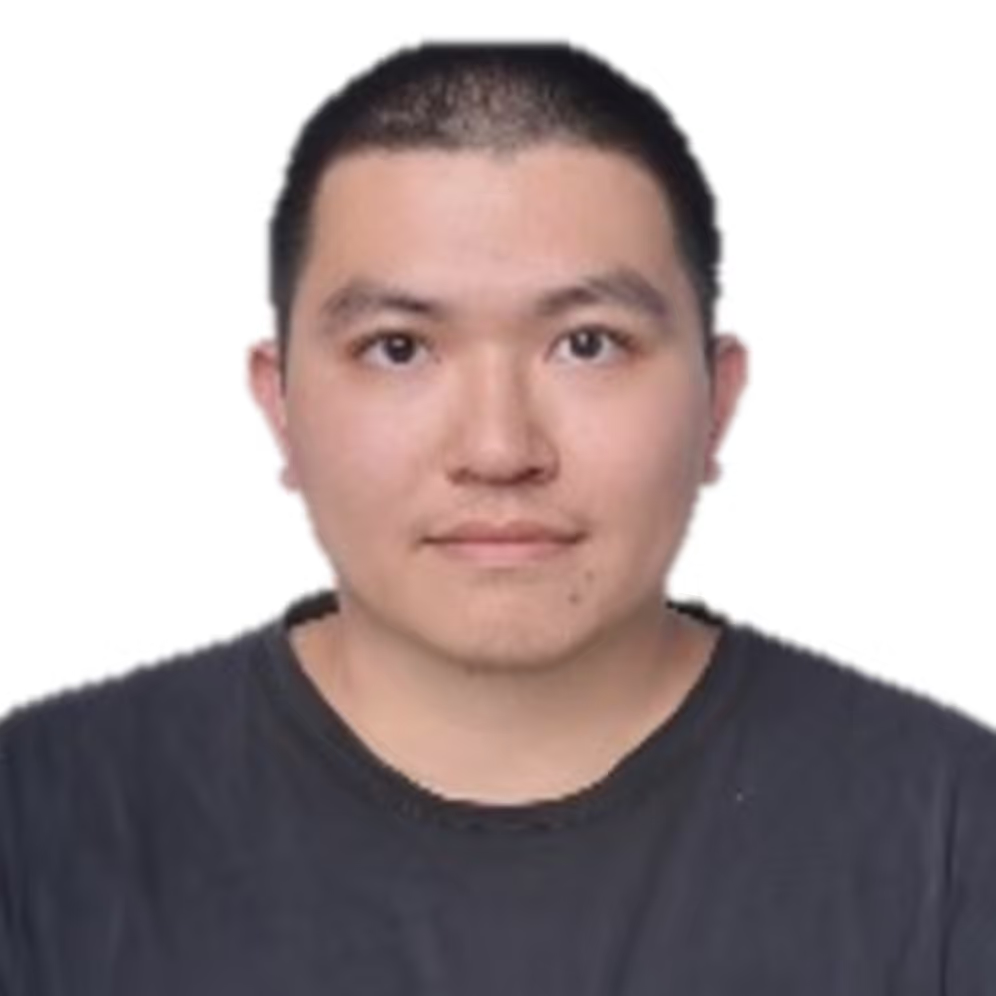
Decoding In Vitro Functional Neural Networks: From Pathophysiological Phenotyping of Brain Organoids to Establishing Novel Models
Interested in sponsoring? Contact us at marketing@mxwbio.com