Organoid-Based Models of Brain Development and Glioblastoma

Register
Register
Date & Time

December 3, 2024 | 17:00 CET
08:00 PST | 11:00 EST | 00:00 CST | 01:00 JST

Tags
Organoids
Disease Modeling
MaxOne

Webinar Hightlights

Register
Register

The webinar covered

  • iPSC-derived organoids as a powerful tool to replicate brain development, function, and pathology.
  • Exploration of the impact of FGF8 signaling on neocortical identity and glioblastoma invasion.
  • The role of HD-MEAs in studying human neuronal organoids and the associated challenges.

Register
Register

Agenda

Modelling Normal and Pathological Brain Development and Function Using Human Organoid Systems

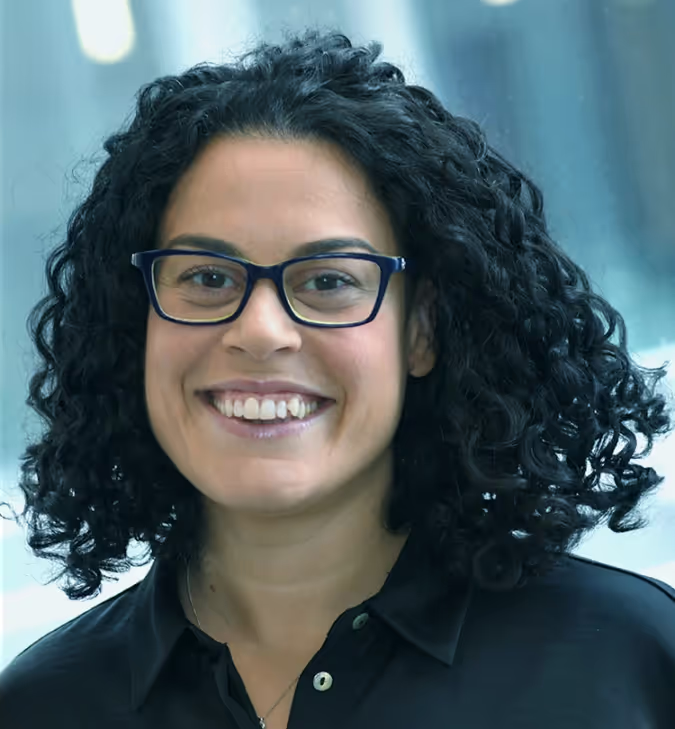
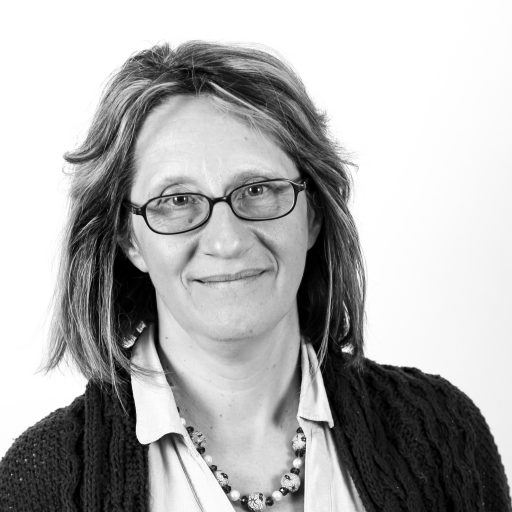
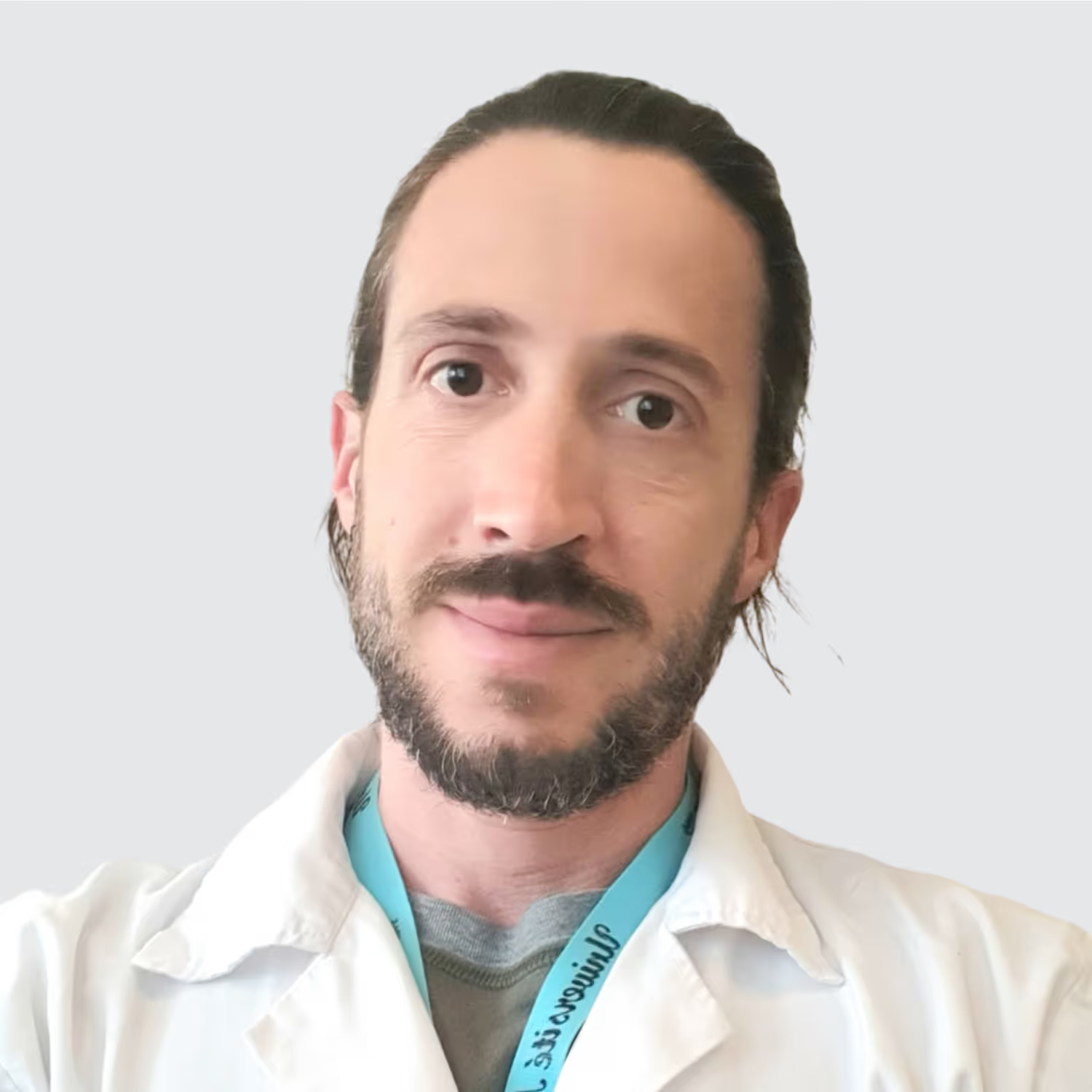
Prof. Dr. Michèle Studer, Dr. Michele Bertacchi

Abstract

Human 3D organoids derived from induced pluripotent stem cells (iPSCs) provide a powerful platform to study human development and disease in vitro, addressing the technical and ethical constraints associated with using human foetal tissue. This approach enables the modelling of complex developmental processes and disease mechanisms. We will present studies ranging from the influence of FGF8 signalling on the regional identity of neocortical organoids to the establishment of an in vitro model of glioblastoma invasion in brain organoids. These examples highlight how we can model brain development and function under both physiological and pathological conditions. From a technical perspective, we will address common challenges in utilizing high-density microelectrode arrays (HD-MEAs) to detect spontaneous electrical activity in human cerebral organoids. We will also discuss troubleshooting strategies to optimize the exploration of neuronal maturation and network functionality in this in vitro system.
Abstract

Speakers

Prof. Dr. Michèle Studer

Institut de Biologie Valrose - iBV (France)

Biography

Dr. M. Studer, PhD, is a well-established scientist in neurobiology with extensive expertise in mouse developmental biology and, more recently, in human brain development. She received her training in leading laboratories in London, UK, including as a postdoctoral fellow at the National Institute for Medical Research (NIMR) and as a Junior Group Leader at King’s College London. At King’s, she was awarded an MRC Career Development Award to establish her own laboratory. In 2000, she broadened her expertise as a visiting scientist at UCSF, USA. Subsequently, she was recruited as a Principal Investigator at the Telethon Institute of Molecular Medicine (TIGEM) in Italy. In 2009, she moved to France as an Inserm Research Director and Group Leader, receiving an ANR Chaire d’Excellence award to investigate the molecular and cellular mechanisms underlying brain organization in physiological and pathological conditions.

Dr. Studer’s research focuses on uncovering the mechanisms that govern the specification of neuronal subtypes during eye and brain development in both normal and pathological contexts. Central to this process are transcription factors uniquely expressed in specific prospective regions and neuronal subtypes, which play essential roles in defining neuronal identity, establishing connectivity, and integrating functional circuits. Understanding these mechanisms is critical for elucidating how brain activity and circuitry are organized to support proper behavior. Her current work examines the role of the morphogen FGF8 in driving brain diversity in human cells (1) and investigates the physiopathological mechanisms of a rare monogenic neurodevelopmental disorder caused by haploinsufficiency of NR2F1, a key transcriptional regulator in brain development (2). Employing a multidisciplinary approach that combines structural bioinformatics (3), animal models (2), and 3D cerebral organoids derived from induced pluripotent stem cells (iPSCs), her team seeks to elucidate the impact of NR2F1 mutations on protein stability, cellular function, and genotype-phenotype correlations associated with the disorder.

Abstract

Dr. Michele Bertacchi

Institut de Biologie Valrose - iBV (France)

Biography

Dr. M. Bertacchi, PhD, is a permanent researcher in developmental neurobiology at Inserm and a member of Dr. Michèle Studer’s team at the Institute of Biology Valrose (iBV) in Nice, France. He earned his PhD at the Scuola Normale Superiore in Pisa, Italy, under the mentorship of Dr. Federico Cremisi, focusing on the role of morphogens in directing retinal versus cortical fate in mouse embryonic stem cells. Supported by a geographic mobility fellowship, Dr. Bertacchi moved to Nice, France, to explore the role of the NR2F1 gene in retinal and cortical differentiation using loss-of-function mouse models. Further advancing his expertise, he received an EMBO short-term fellowship to work in Dr. Silvia Cappello’s lab, where he specialized in human brain organoids to study early fetal brain development. Currently, he is recognized as the reference expert for brain organoid technology at iBV. His primary research focuses on NR2F1, a transcriptional regulator with critical roles in brain and eye development, whose deletion is implicated in neurodevelopmental diseases in humans. His work also investigates genetic factors influencing glioblastoma, with a focus on understanding the mechanisms that drive the tumor aggressiveness and invasiveness.

Abstract

Hosts

Dr. Laura D'Ignazio

Head of Commercial Excellence and Engagement | MaxWell Biosystems (Switzerland)

Recording available

Sign Up for the Updates

Register

You can unsubscribe from marketing emails at any time. For details, see our Privacy Policy.

Submit
谢谢!您提交的内容已收到!
哎哟!提交表单时出了点问题。
MaxWell