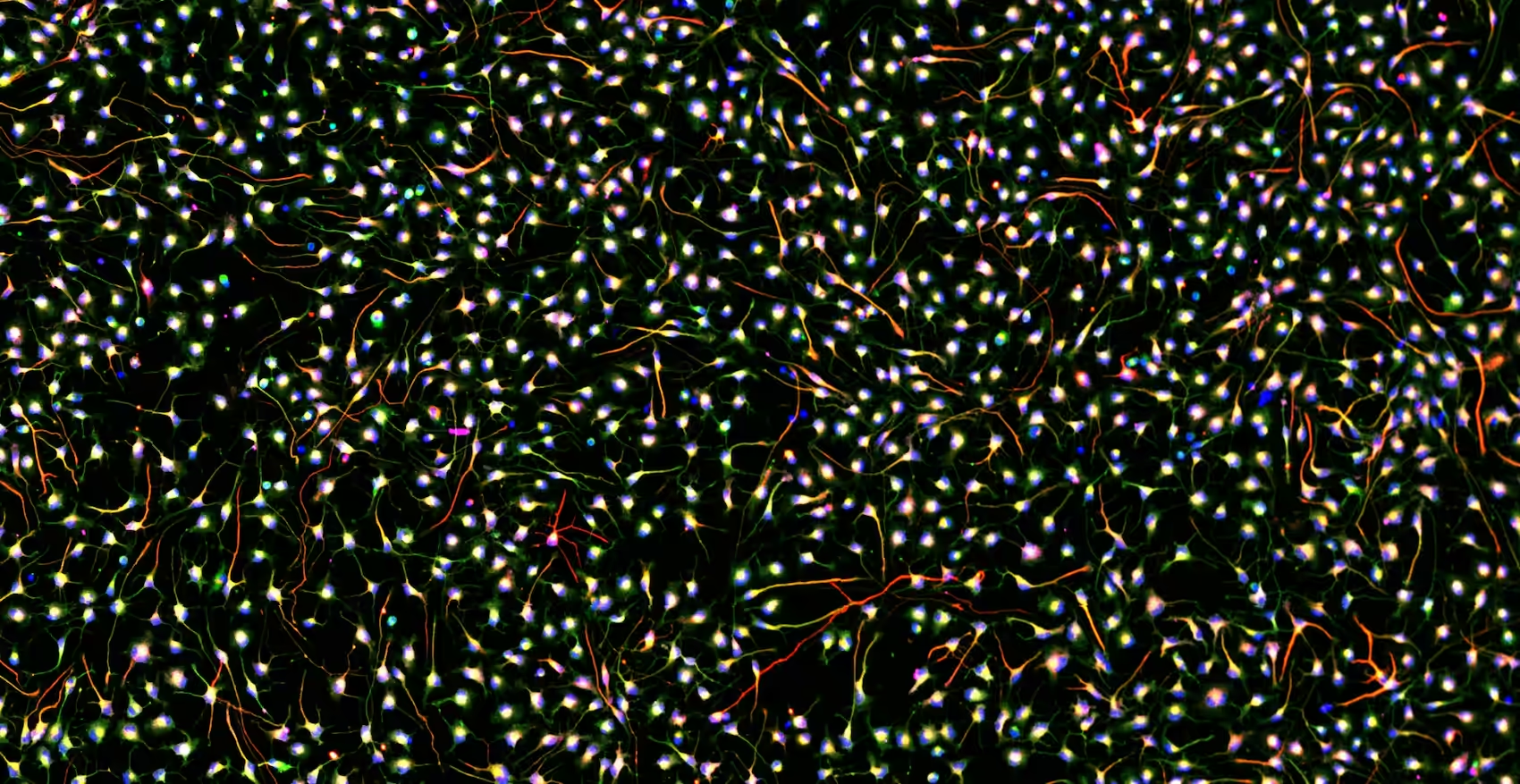
How Can Engineered Neuronal Networks Advance Neurocomputing?

Prof. Hideaki Yamamoto answers questions left open during our webinar on engineered neuronal networks, closed-loop reservoir computing, and biological computation.
Author
Date
Tags
Many of you joined our webinar, Advancing Neurocomputing with Engineered Neuronal Networks and High-Content Electrophysiology, featuring Prof. Hideaki Yamamoto’s talk, Closed-Loop Reservoir Computing with Engineered Neuronal Networks on HD-MEAs.
The presentation explored how cultured neuronal networks can be engineered to investigate cortical computation. By controlling network architecture and modular connectivity, researchers can study how structure shapes neuronal dynamics and the computations a network can support. Prof. Yamamoto also presented how the high-dimensional activity of these networks can be harnessed for autonomous temporal pattern generation within a closed-loop reservoir computing framework.
These experiments rely on the combination of large-scale spatial coverage, sub-millisecond temporal resolution, and bidirectional recording and stimulation offered by high-density microelectrode arrays.
The discussion generated more questions than we could address during the live session. Below, Prof. Yamamoto responds to the remaining audience questions on feedback stimulation, reservoir computing, open theoretical challenges, biological versus artificial neural networks, and training across multiple days.
Feedback Stimulation and Reservoir Computing
Question from the audience
Your feedback is a spatial stimulation, meaning that depending on the amplitude of the signal you choose the stimulation electrode (I hope I got this correctly). This itself is a non-linear mapping, do you not solve / create a reservoir already at this stage? Meaning you could remove the BNN and simple take the stimulation pattern directly as your reservoir and hence be way more efficient. (I guess my second question was answered by the fact that all electrodes that are stimulated get the same pulse at the same time).
Prof. Yamamoto's answer
In our system, the feedback is not implemented by dynamically choosing a stimulation electrode according to the instantaneous output. Rather, feedback stimulation is delivered through a predefined set of electrodes. For this particular work, we did not test direct regression from the feedback stimulation patterns without the BNN. However, in our previous work (Sumi et al., PNAS 2023), we showed that BNNs can contribute to the system by transforming input patterns into neural activity patterns that better support generalization.
Open Challenges in Biological Computing
Question from the audience
Have you faced any open problems about biocomputing? Specifically theoretical ones
Prof. Yamamoto's answer:
Quite a lot. Variability and instability are obvious ones, for instance. I think the interesting point is that biology somehow works under these limitations, and there must be a way to decode information accurately out from highly variable sources.
Applications of Biological Neural Networks and Comparison with ANNs
Question from the audience
What are the possible applications of the engineered biological neural networks besides understanding the neuroscience better? Will it outperform artificial neural networks? There's a paper by Beniaguev et al. (Neuron 2021) that shows that it takes 5-8 layers of deep neural networks to approximate the input-output mapping of a single biological neuron.
Prof. Yamamoto's answer:
That could, in a way, be taken as a characteristic where biology is "outperforming" ANNs, but I think comparing BNNs and ANNs is like comparing apples to oranges. Scientifically, it's more important to look for its own applications.
Training Biological Neural Networks Across Multiple Days
Question from the audience
If you train the same network over different days, do you find that they become easier to train?
Prof. Yamamoto's answer:
We are aware that some papers, e.g., Cai et al. (Nature Electronics 2023) and Mritunjay et al. (Nature Electronics 2026), that have looked into those aspects. We have not tested them yet in our systems, but I agree that they are very interesting profiles.
Continue Exploring Neurocomputing
These questions highlight some of the fundamental opportunities and open challenges in biological computing. Living neuronal networks are variable, adaptive, and highly complex - characteristics that make them difficult to predict and control, but that may also enable forms of information processing that differ fundamentally from conventional artificial systems.
The full webinar replay is available! Watch the complete presentation to learn more about Prof. Yamamoto’s research and follow the questions discussed during the live session.
You can also visit our dedicated Focus on Neurocomputing page, where we bring together webinars, publications, expert perspectives, and other resources exploring this rapidly developing field. Stay tuned as we continue to add new insights and research.
Would you like to hear more from Prof. Hideaki Yamamoto? Join us at NeuMoS 2026, where he will present his latest work on physical reservoir computing with engineered neuronal networks alongside other leading researchers advancing in-vitro neuronal models, biocomputing, disease modeling, and drug discovery.
Related
Resources
MaxOne
Versatility and functionality in one compact device

Our Technology
Multi-/Micro-electrode Arrays

Biocomputing

Neuronal Cell Cultures