ISSCR - Accelerating PSC-Derived Cell Therapies: Starting with the End in Mind

Date
11-12 December, 2025
Time
Location
Boston, USA

The ISSCR Meeting is the leading global conference dedicated to advancing stem cell science and pluripotent stem cell (PSC)-derived therapies.
Each year, researchers, clinicians, and industry experts come together to share breakthroughs in ESC/iPSC biology, regenerative medicine, and cell-based therapeutic development.

ISSCR 2025 in Boston will highlight how starting “with the end in mind” is shaping the next generation of PSC-derived cell therapies—from early discovery through to clinical translation.

We are excited to be part of this year’s meeting: visit our booth to discover our latest technologies and what’s new.
You can also find us at our poster presentation and join our Innovation Showcase to see how HD-MEA functional readouts accelerate stem cell research and reveal new functional insights.

Meet the MxW Team

Dr. Carlos Sanchez Priego

Field Application Scientist | MaxWell Biosystems (Switzerland)

Biography

Dr. Francesca Puppo

Field Application Scientist | MaxWell Biosystems (Switzerland)

Biography

Dr. Marie Obien

CCO | MaxWell Biosystems (Switzerland)

Biography

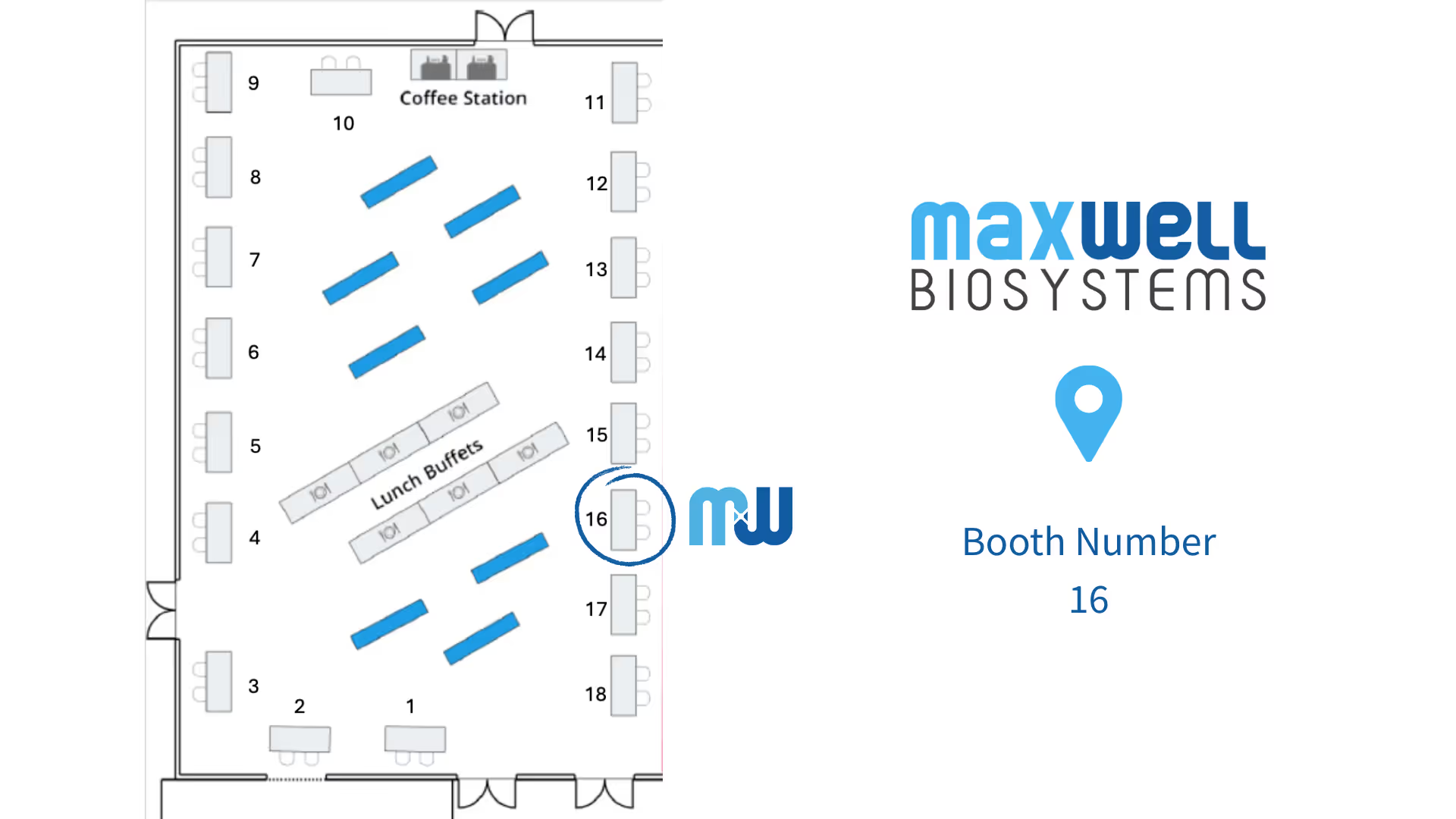
MxW Booth

Visit us at our booth! 

Come say hi, and see what's new! Our team of experts is available to discuss how MaxWell Biosystems' HD-MEA Technology can support your stem cell research.

Innovation Showcase

Join MaxWell Biosystems' Innovation Showcase! Secure a spot by registering using the form below.

12 December | 1:45 PM – 2:05 PM
HD-MEA Functional Readouts for Translating iPSC-Derived Models Toward Preclinical Applications

The complexity and heterogeneity of many diseases, particularly neurodegenerative disorders, underscore the urgent need for personalized therapeutic strategies. At the same time, growing ethical and translational limitations of animal research have accelerated the search for alternative approaches. Induced pluripotent stem cells (iPSCs) have emerged as a transformative tool to model disease and enable drug discovery directly in human-relevant systems. Several iPSC-based therapies are already advancing toward clinical application, yet realizing their full potential requires technologies capable of delivering precise, high-content functional insights.  

MaxWell Biosystems’ High-Density Microelectrode Arrays (HD-MEAs), including the MaxOne and MaxTwo platforms, provide a powerful, non-invasive approach to capture high-resolution electrophysiological data from iPSC-derived neuronal networks. These platforms enable researchers to assess neural activity and maturation with exceptional detail and reproducibility.  

In this Innovation Showcase, we highlight how HD-MEAs can provide essential functional readouts to accelerate the translation of iPSC-derived models toward therapies suitable for preclinical evaluation.

Dr. Francesca Puppo
Field Application Scientist | MaxWell Biosystems (Switzerland)

Poster 
Presentations

Dr. Francesca Pppo

Field Application Scientist

11 December, 2025 | 6:15 PM - 7:15 PM | Poster Number 120

Label-free functional characterization of iPSC-derived neurons at subcellular resolution

Abstract

Induced pluripotent stem cell (iPSC)-derived brain models have become a fundamental tool for studying common neurological disorders, such as epilepsy, Alzheimer’s disease, and Parkinson’s disease. Being able to measure the electrical activity from these in vitro models in real time and label-free offers critical insights into the complexity of neuronal networks. Nowadays, the integration of single cell resolution with high-throughput physiological assays is especially valuable, as it can deepen our understanding of subtype-specific neuronal activity, yet it remains challenging to achieve.

In the present study, High-Density Microelectrode Array (HD-MEA) platforms (MaxWell Biosystems, Switzerland), were used to perform in vitro extracellular recordings of action potentials across entire neuronal networks, single neurons and even subcellular compartments. Additionally, we showed the advantages of having HD-MEA systems featuring 26,400 electrodes per well, since they play a crucial role in enhancing the statistical power gathered from iPSC-derived neurons over multiple days/weeks and in capturing even the smallest neuronal signals.

Finally, we present the Axon Tracking Assay, a tool for automated recording and analysis of individual axonal arbors of many neurons in parallel. The Axon Tracking Assay enabled the obtention of metrics such as potential conduction velocity, axonal length, and number of axonal branches. Therefore, with this unique method we characterized the function and axonal structure of different iPSC-derived neuronal cell lines.

Our HD-MEA platforms and the extracted metrics, such as firing rate, spike amplitude, and network burst profile among several others, provide an extremely powerful and user-friendly approach for in vitro drug screening and disease modelling.

Biography

Workshops

Join MaxWell Biosystems' Innovation Showcase! Secure a spot by registering using the form below.

No items found.

Register

Which activities are you attending?

You can unsubscribe from marketing emails at any time. For details, see our Privacy Policy.

Submit
Thank you! Your submission has been received!
Oops! Something went wrong while submitting the form.
MaxWell