MxW Connect – San Diego 2026
Driving Innovation in Disease Modeling through High-Content Electrophysiology
.avif)
Place
2880 Torrey Pines Scenic Drive
La Jolla, CA 92037 (USA)
Date
Time & Program
Welcome Remarks
Invited Talks
Reception & Networking

An Evening of Scientific Insight and Meaningful Networking
Join us in San Diego for an evening exploring how high-content electrophysiology is advancing disease modeling and opening new paths for innovation. Through scientific talks and networking, the event will bring together researchers and innovators for discussion, exchange, and connection across the field.
Come for the science, stay for drinks and bites.
Secure your spot by registering using the form below.

Confirmed Speakers

Epigenetic Gene Therapies for Next-Generation Pain Therapeutics and Beyond
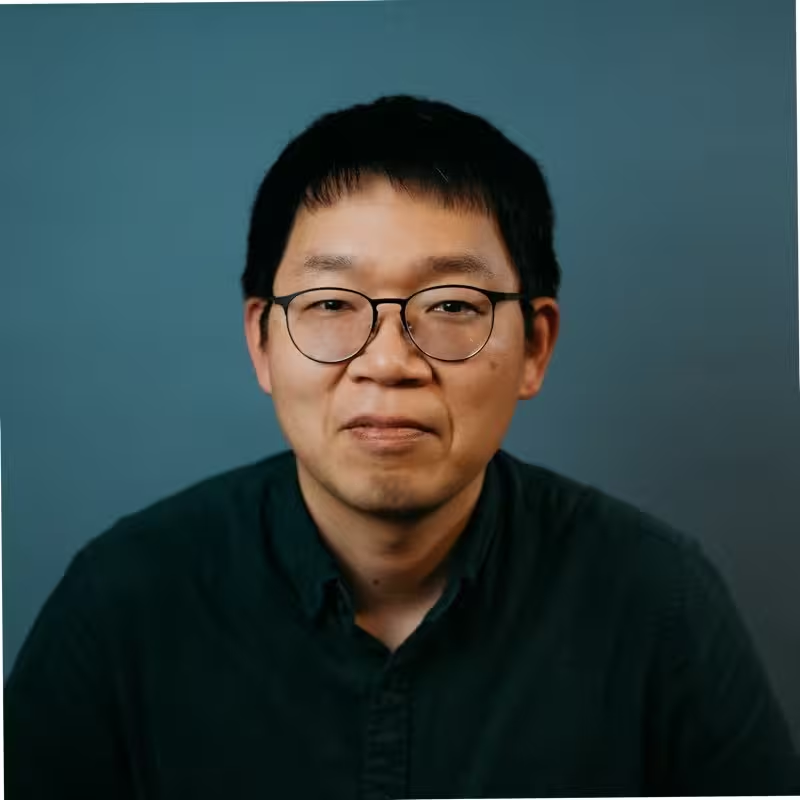
Seungkyu Lee is a Sr. Principal Scientist in the Neuroscience TRC at Bristol Myers Squibb (BMS). He joined Celgene/BMS in 2019 following his postdoctoral training at Boston Children’s Hospital, where one of his researches focused on target identification and screening for ALS hyperexcitability using iPSC neurons. He earned Ph.D. in biochemistry from the Gwangju Institute of Science and Technology. His current research focuses on Alzheimer’s disease drug discovery.
Neuronal Functional Assessment for Preclinical Development of Neurodegenerative Disease Therapeutics
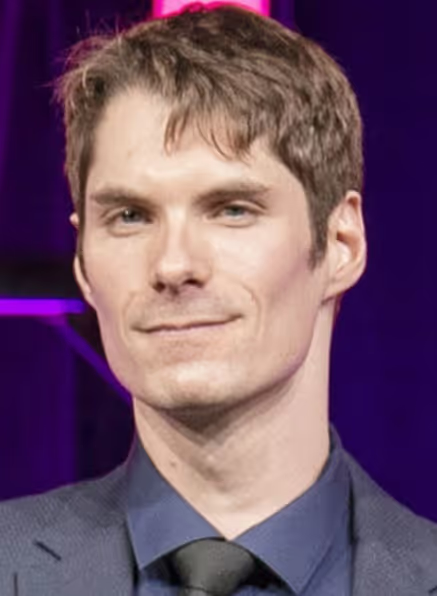
Patrick Walsh CEO of Anatomic is a career stem cell biologist with experience spanning more than 15 years across both academic and industrial positions. His graduate work from the University of Minnesota Stem Cell Institute involved early technology development in the field of cellular reprogramming toward pluripotency. Following graduation, Patrick translated this expertise to Lonza Walkersville's Pluripotent Stem Cell Innovation Center focusing on current good manufacturing practices (cGMP) -compliant stem cell culture systems and reprogramming, where he developed several commercialized technologies. Patrick subsequently returned to the University of Minnesota Stem Cell Institute to lay the groundwork for their cGMP-compliant production of induced pluripotent stem cells (iPSCs) and to learn about differentiation of iPSCs into ectodermal cell types. During this second project, Patrick discovered the technical origins underpinning the founding of Anatomic Incorporated, where his team is revolutionizing the rapid and efficient, stepwise directed differentiation of all cell types from pluripotent stem cells. Anatomic is most well known for its dorsal-root ganglia, trigeminal sensory, and dorsal horn neuronal platforms accelerating discovery in pain neurobiology.
Completing the Circuit: Advanced NAMs for Neurobiology and Beyond

Dezmond is a Field Application Scientist at FUJIFILM Cellular Dynamics with over 15 years of biomedical research experience spanning human iPSCs, mesenchymal stem cells, and animal models. His current work focuses on leveraging terminally differentiated iPSCs for disease modeling, toxicology, and discovery research. Dezmondearned his Ph.D. in Physiology and Biophysics through a joint program between the National Institutes of Health and Howard University, where he investigated the genetic causes of childhood obesity. He later completed a postdoctoral fellowship at the Gladstone Institutes, researching HIV latency.
Pushing the Boundaries of Drug Discovery and Neurodegenerative Disease Modeling by combining human iPSC-derived neurons and HD-MEA
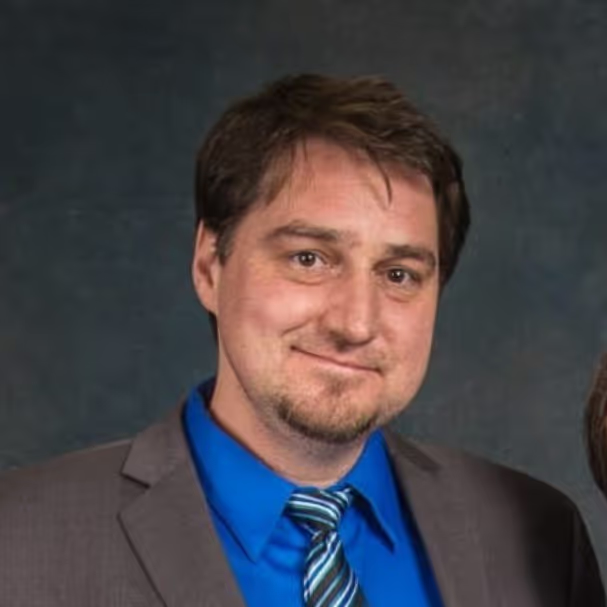
Shaun is a graduate of the prestigious CIRM Bridges program focused on stem cell applications. He held a research position at NASA, followed by a small biotech company before pivoting to technical commercial roles. Always focused on bringing innovative solutions to scientists that aim to help patients.
Scalable iPSC-Derived Neural Models for HD-MEA and New Approach Methodologies (NAMs)