MxW Connect – San Francisco 2026
Organoids and Biocomputing: Exploring New Frontiers through High-Content Electrophysiology

Place
Building ChEM-H Neuro, room S275,
290 Jane Stanford Way,
Stanford, CA 94305, (USA)
Date
Time
Welcome Remarks
Invited Talks
Reception & Networking

Scientific Talks, Community Exchange, and Networking
Join us in Stanford for an evening exploring how high-content electrophysiology is advancing new frontiers in organoid research and biocomputing. Through short scientific talks and networking, the event will bring together researchers and innovators for discussion, exchange, and connections across the field.
Come for the science, stay for drinks and bites.
Secure your spot by registering using the form below.
Confirmed Speakers

Tal Sharf is an Assistant Professor in the Department of Biomolecular Engineering at UC Santa Cruz. Tal received his BS in Physics at UC Santa Barbara where he studied turbulence in thermally driven convection in the lab of Guenter Ahlers. Tal then pursued doctoral work in the nanoelectronics lab of Ethan Minot at Oregon State University where he developed biosensors based on carbon nanotube and graphene transistors. Inspired by the BRAIN initiative, Tal pursued postdoctoral training under neurobiologist Kenneth Kosik at UC Santa Barbara’s Neuroscience Research Institute where he received the Arnold O. Beckman postdoctoral fellowship award. While at UCSB, Tal generated the first high-resolution map of functional connectivity between neurons in human-iPSC derived brain organoids. In July of 2022 Tal started his lab at UC Santa Cruz where he works at the intersection of physics, biology and computation to understand the assembly and wiring of human brain circuitry.
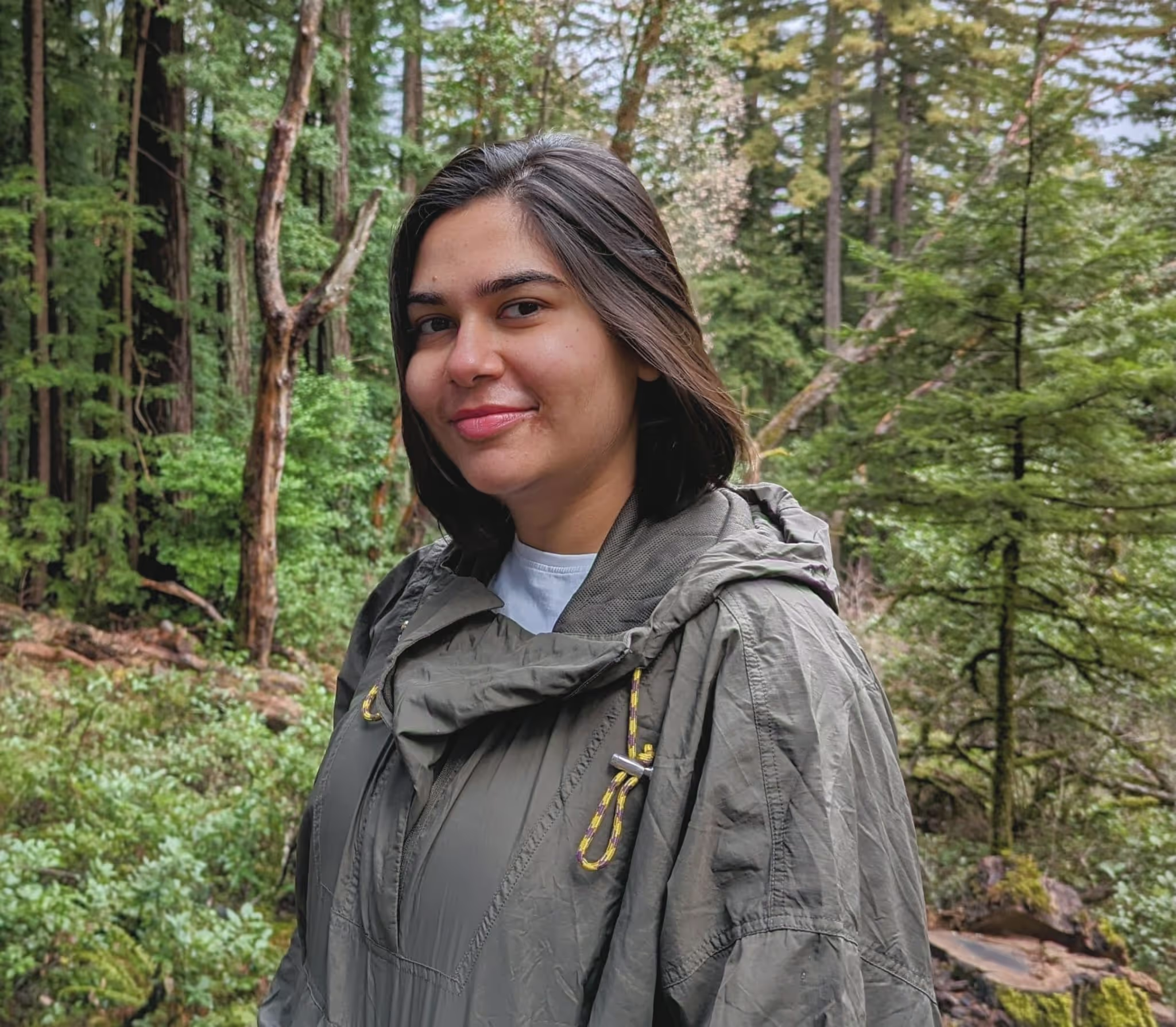
Dhriti is a Postdoctoral Research Scientist in the Department of Pediatrics at Stanford University, working in the laboratory of Dr. Anca M. Pașca. Her research harnesses iPSC-derived brain organoids and assembloids to model neonatal brain injury, rare neurological conditions, and 22q11.2 deletion syndrome, with a focus on mitochondrial dysfunction, interneuron vulnerability, and therapeutic rescue strategies.
Longitudinal High-Density Electrophysiological Profiling of Human Cortical Organoids Reveals Dynamic Network Remodeling Across Hypoxia-Reoxygenation Injury
Parvalbumin Interneurons as drivers of cortical circuit assembly
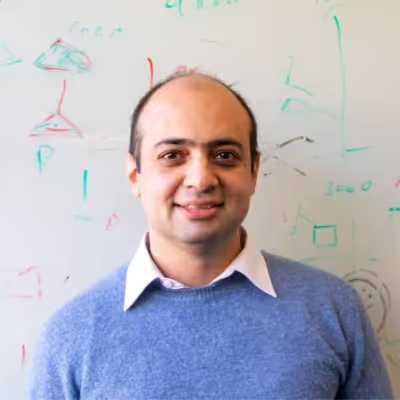
Dr. Mohammed Mostajo-Radji is an Associate Research Scientist at the UCSC Genomics Institute where he studies the specification of cortical circuits using organoid models. He completed his PhD in Molecular and Cellular Biology at Harvard University where he focused on reprogramming of postmitotic neurons and his postdoctoral work at UCSF developing chimeric organoid models to study neuronal specification. Besides his scientific work co-leads the data coordination center for the SSPsyGene consortium, a nation-wide initiative to systematically characterize high confidence mutations in neuropsychiatric conditions.

Mircea Teodorescu is an Associate Professor at the University of California, Santa Cruz, with appointments in Electrical and Computer Engineering, Biomolecular Engineering, and as Director of Bioelectrical Engineering at the UCSC Genomics Institute. His lab develops scalable in vitro platforms for neuroscience by integrating microsystems engineering, real-time biological data acquisition, and neural tissue modeling. Combining principles from mechanical, electrical, and computer engineering, his team addresses challenges in biomolecular engineering, biomechanics, and assistive technology through mathematical modeling, embedded systems, rapid manufacturing, and advanced sensing.
Realtime Spikes and Organoid Showdown: Live Demo
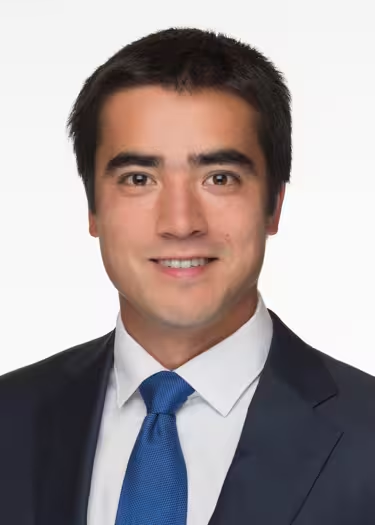
Yohei Rosen is a postdoctoral scholar in the University of California Santa Cruz Genomics Institute. His research focuses on automated biology, agentic science, computational tools, live cell imaging and vascularized organoids. As part of the Braingeneers research group, he specializes in creating scalable technologies to automate and advance the study of brain organoids.
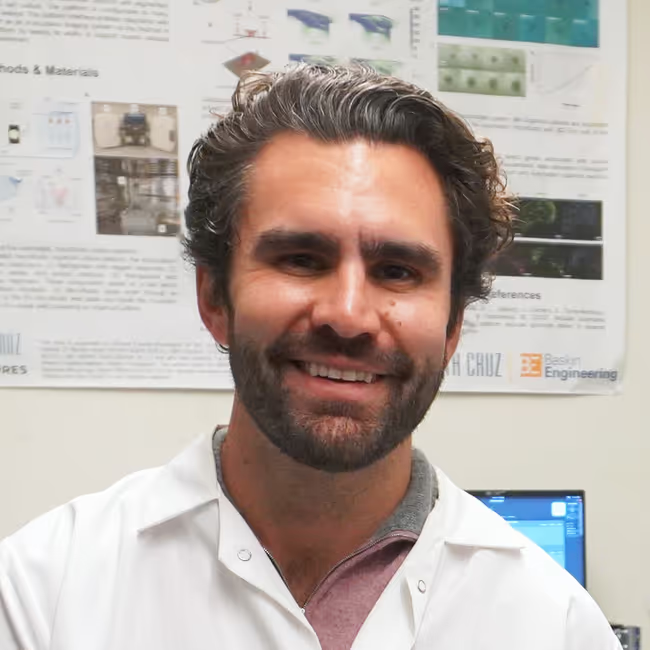
Spencer Seiler, PhD is Co-Founder and CEO of Open Culture Science, where he leads development of Habitat, a microfluidic lab-in-a-loop platform for automated organoid experimentation. He holds a PhD in Biomolecular Engineering from UC Santa Cruz and brings prior engineering experience from Berkeley Lights, Ultima Genomics, and Miroculus, with published work across nanotechnology and automated microfluidics.
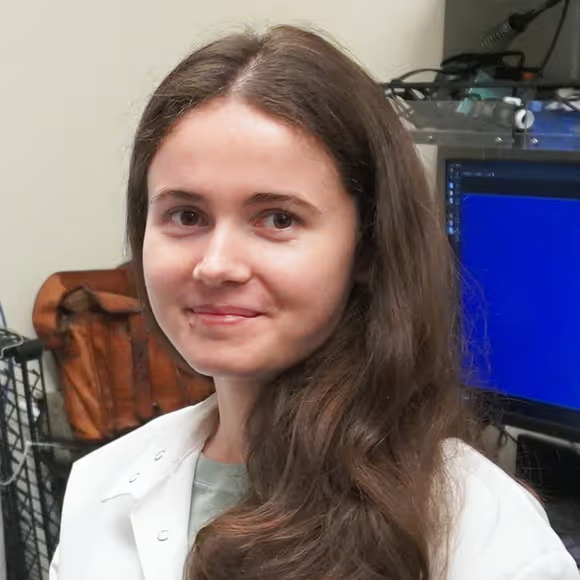
Kateryna Voitiuk, PhD is Co-Founder and CTO of Open Culture Science, where she leads R&D for Habitat hardware, consumables, and Cloud integration. A founding researcher of the Braingeneers with a PhD from UC Santa Cruz, she is a lead author on the IoT cloud laboratory, Piphys electrophysiology, and Nature Neuroscience closed-loop optogenetics work that underpins remote, feedback-driven organoid experimentation.
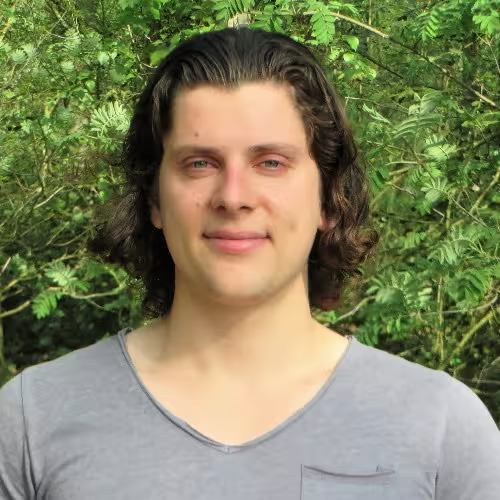
Tjitse van der Molen, PhD is Head of Intelligence at Open Culture Science and first author of SpikeLab, an agentic framework that gives LLMs the bounded autonomy needed to analyze neural spike data correctly. He led the data analysis for one of the earliest HD-MEA recordings of human brain organoids and is lead author on a recent Nature Neuroscience study comparing circuit activity across in vitro models.
SpikeLab and Habitat: Agentic Tools for Lab-in-a-Loop on HD-MEA
Register
Interested in sponsoring? Contact us at marketing@mxwbio.com